GEOTECHNICAL ENGINEERING
NEWARK

Geotechnical Engineering in Newark

Evidence-based design. Reliable delivery.

LEARN MORE

The soil profile shifts dramatically between the Ironbound District and the North Ward in Newark. The Ironbound sits on thick layers of compressible organic silts near the Passaic River floodplain, while the North Ward encounters dense glacial till at relatively shallow depths. A standard footing design that works near Branch Brook Park often fails in the eastern parts of the city. In Newark, a soil mechanics study must isolate these transitions block by block. We run index tests and strength tests on undisturbed samples to produce parameters the structural engineer can use. This data feeds directly into bearing capacity calculations and settlement predictions. For sites with deep soft clay, we often recommend supplementing the lab program with a CPT test to get a continuous profile of tip resistance and sleeve friction before sampling intervals are selected.

A consolidation test on a 1-inch thick specimen from the Meadowlands clay can predict 20 years of settlement in 48 hours.
Geotechnical Engineering in Newark
Technical reference — Newark

Our service areas

Local geology

Our triaxial frame sits in a temperature-controlled room near the Newark lab bench. It applies confining pressures up to 200 psi using a GDS pressure-volume controller. The system logs deviator stress and pore pressure at 1-second intervals. We run consolidated-undrained tests with pore pressure measurement for the varved clays common in Newark's Meadowlands area. Specimens are trimmed to a 2.8-inch diameter, saturated using back pressure until a B-value of 0.95 is reached, then sheared at a rate of 0.001 inches per minute. The stress-strain curves and effective stress paths tell us whether a soil will strain-soften under load. When the site includes fill over marsh deposits, the triaxial data pairs well with an Atterberg limits analysis to classify the plastic silts and confirm their behavior under saturation.

Relevant standards

ASTM D4767 – Triaxial Compression Test, ASTM D2435 – One-Dimensional Consolidation, ASTM D4318 – Atterberg Limits, ASTM D2487 – USCS Classification, IBC 2021 – Chapter 18 Soils and Foundations

Need a geotechnical assessment?

Reply within 24h.

Email: contact@geotechnical-engineering.vip

Why choose us

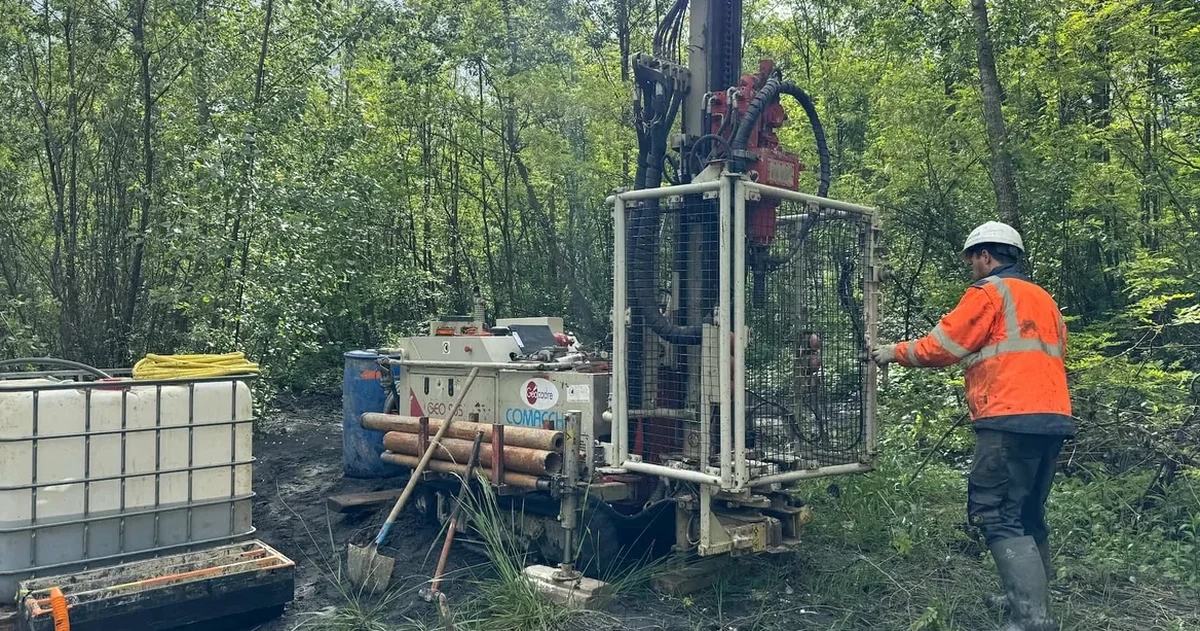
The most common mistake we see in Newark is assuming the glacial till is uniform. A contractor hits a boulder at 15 feet and stops drilling, reporting refusal on bedrock. The real bearing stratum might sit 40 feet deeper. The rig hit an erratic boulder, not the formation. A soil mechanics study with careful logging of each sampler run catches this. If the project proceeds on a false refusal, the foundation settles unevenly. Within two winters, freeze-thaw cycles open cracks in the slab. Remediation costs triple the original geotechnical budget. We log every split-spoon drive, measure recovery, and photograph the cuttings. No shortcuts. The lab data from consolidation tests and direct shear tests then confirms the actual bearing layer and its compressibility.

Technical data

ParameterTypical value
Triaxial shear strength (CU, effective stress)c' = 0–200 psf, φ' = 20°–35° (typical Newark varved clay)
Preconsolidation pressure (Pc)0.5–3.0 tsf (Meadowlands organic silt)
Compression index (Cc)0.15–0.40
SPT N-value correlationN60 = 4–12 (soft clay), N60 = 30–50+ (dense till)
Soil classification (USCS)CL, CH, ML, SP-SM (per ASTM D2487)
Hydraulic conductivity (lab flexible wall)1x10⁻⁶ to 1x10⁻⁸ cm/s

Common questions

How much does a soil mechanics study cost for a typical lot in Newark?

For a single-family residential lot in Newark, a soil mechanics study typically ranges from US$3,120 to US$5,820. The final cost depends on the number of borings, the depth to bearing stratum, and the lab tests required. A site in the Ironbound with deep soft clay will need more consolidation tests than a site in the North Ward on shallow till, which affects the total.

How long does the lab testing take once samples arrive?

Routine index tests take 3 to 4 business days. Consolidation tests run about a week per specimen because each load increment must reach 90% primary consolidation. Triaxial tests on low-permeability Newark clays can take 5 to 7 days including saturation and shear stages. We schedule tests in parallel to keep the total turnaround under two weeks for most projects.

Do you need a drilling crew or can you test samples we provide?

We test samples provided by any licensed drilling contractor in New Jersey. The samples must arrive in sealed Shelby tubes or jars, properly labeled with depth and boring number. We do not operate our own drill rig, but we can recommend local Newark drillers who understand the Meadowlands formation and the glacial stratigraphy.

Location and service area

We serve projects in Newark and surrounding areas.

View larger map