GEOTECHNICAL ENGINEERING
NEWARK
HomeLaboratoryLaboratory CBR test

Laboratory CBR Testing in Newark: Why Guessing the Bearing Ratio Can Wreck Your Pavement

Evidence-based design. Reliable delivery.

LEARN MORE

The most expensive mistake we see in Newark pavement jobs is simple: designing the asphalt and base course on assumed numbers. A contractor grabs a 'typical' CBR of 10 or 12, copies a generic cross-section from a manual, and nine months later the parking lot at Ferry Street is alligator-cracked and the owner is furious. The Laboratory CBR test on actual subgrade samples—compacted at optimum moisture and soaked for 96 hours—gives you the real bearing ratio your soil can hold. Newark sits on a mix of glacial outwash, recent alluvium along the Passaic River, and pockets of urban fill that can swing from dense gravel to organic silt in the same block. Skimping on this test means either overbuilding and wasting thousands in stone, or underbuilding and eating a warranty claim. When we prepare a sample, we're replicating the worst-case moisture scenario that Newark's freeze-thaw cycles and high water table will impose on your pavement section year after year.

A lab CBR value of 4 versus 8 can mean the difference between 12 inches of base course and 6 inches—on a 20,000-square-foot lot, that's real money.
Our service areas

How we work

Newark's elevation averages barely 30 feet above sea level, and much of the city's commercial and industrial corridor sits on historically marshy ground that was filled in over the past century. That means your subgrade could contain anything from dredged river sand to demolition debris, and the CBR value can vary from 3 percent—barely better than fat clay—to over 40 percent in a well-graded gravel lens just a few feet away. Our Laboratory CBR test follows ASTM D1883, using a 2-inch penetration piston at 0.05 inches per minute, and we always run both the unsoaked and the four-day soaked condition because Newark's groundwater is shallow and rising. The procedure gives you a direct comparison to the standard crushed-stone reference material, so your pavement engineer can plug real numbers into the AASHTO 1993 or MEPDG design method instead of guessing. For projects near the port or along McCarter Highway where truck traffic is relentless, combining the soaked CBR with a grain-size analysis reveals whether fines migration under repeated loading is going to be a long-term problem, especially in the silty sands common in the Ironbound district. We also recommend a plate load test on the compacted lift if the pavement will support heavy container handling equipment, because the CBR alone doesn't capture the stiffness of the entire layered system.
Laboratory CBR Testing in Newark: Why Guessing the Bearing Ratio Can Wreck Your Pavement
Technical reference — Newark

Local geotechnical context

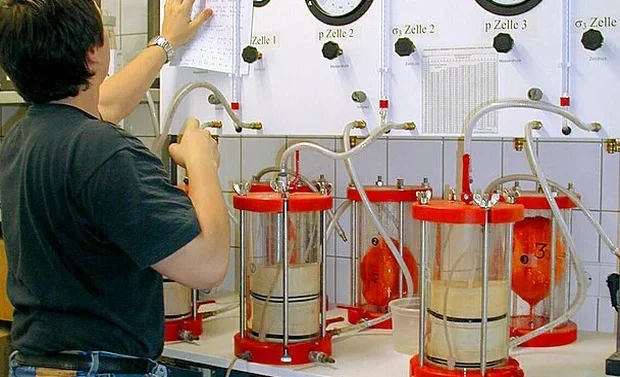
The lab setup for a soaked CBR doesn't look dramatic—just a cylindrical soil sample sitting in a water bath with a metal surcharge plate on top, hooked up to a dial gauge for swell readings over four days. But what that quiet setup reveals is whether your subgrade will turn into a sponge. In Newark, where the Passaic and Hackensack river systems keep the water table within a few feet of grade in many neighborhoods, ignoring the soaked condition is practically negligence. We've measured over 8 percent swell in some of the red-brown silts found near Weequahic Park, which translates to differential heave that tears apart asphalt within two winters. The other failure mode we catch in the lab is a CBR drop from 15 percent unsoaked down to 3 percent soaked—classic behavior of a moisture-sensitive silt that loses all bearing capacity when saturated. If the soaked CBR falls below the design threshold, you either need to stabilize the subgrade with cement or lime, undercut and replace, or thicken the structural section. Finding that out during construction means a change order; finding it out after the fact means a lawsuit.

Need a geotechnical assessment?

Reply within 24h.

Email: contact@geotechnical-engineering.vip

Video resource

Relevant standards

ASTM D1883 (Laboratory CBR), ASTM D698 / D1557 (Moisture-density relationship), AASHTO T 193 (CBR of laboratory-compacted soils), IBC Chapter 18 (Soils and Foundations, referencing geotechnical investigation requirements)

Technical data

ParameterTypical value
StandardASTM D1883 (Standard Test Method for CBR)
Sample preparationCompacted at optimum moisture per ASTM D698 or D1557
Soaking period96 hours submerged, with swell measurement
Penetration rate0.05 in/min (1.27 mm/min)
Reported valuesCBR at 0.1-inch and 0.2-inch penetration, plus swell %
Sample size6-inch diameter mold, typically 3-point compaction curve
Surcharge weightEquivalent to pavement weight (typically 10 lb annular surcharge)
Typical Newark soilsSandy silt (ML), silty sand (SM), urban fill with brick/concrete fragments

Common questions

What does a laboratory CBR test cost in Newark?

A standard single-point CBR test with a 96-hour soak typically runs between US$140 and US$200, depending on whether it's part of a larger geotechnical investigation package. A three-point CBR curve, which gives you the bearing ratio across a range of densities, falls on the higher end of that range. For commercial projects in Newark's redevelopment zones, the cost of the test is negligible compared to the risk of overdesigning or underdesigning a pavement section.

How long does the soaked CBR test take from start to finish?

The full sequence takes about a week. We compact the sample—which takes a day if we need to run a Proctor first to find optimum moisture—then submerge it under water for 96 hours (four days) while measuring swell, and finally run the penetration test on day five. You'll have the final report within seven business days from when we receive the bulk soil sample.

Do I really need a soaked CBR for a parking lot in Newark?

Yes, and here's why: Newark's water table is high across much of the city, and the silty soils common in the area lose significant strength when saturated. An unsoaked CBR might read 15 or 20, giving you a false sense of security. After four days of soaking, that same soil can drop below 5. If you design with the unsoaked number, the pavement will fail prematurely—we've seen it happen on commercial lots off Broad Street where groundwater wasn't considered.

What's the difference between a field CBR and a laboratory CBR?

A field CBR test uses a reaction truck and a penetration piston driven directly into the in-place subgrade, which is quick but doesn't account for worst-case moisture. A laboratory CBR test compacts the soil at a controlled density and moisture, then soaks it for four days to simulate the saturated condition that causes most pavement failures. The lab test gives your engineer the conservative design value that keeps the pavement alive through Newark's wet winters and spring thaw cycles.

Location and service area

We serve projects in Newark and surrounding areas. More info.

View larger map