GEOTECHNICAL ENGINEERING
NEWARK
HomeGround improvementStone column design

Stone Column Design in Newark – Ground Improvement for Soft, Compressible Soils

Evidence-based design. Reliable delivery.

LEARN MORE

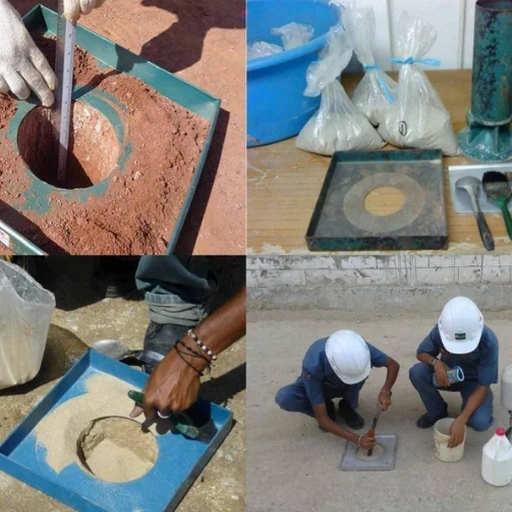
The contrast between the dense glacial till up near Branch Brook Park and the soft, organic silts along the Passaic River couldn't be more stark. A foundation that holds firm near University Heights might need a completely different strategy south of Market Street where the Meadowlands once dominated. That's where stone column design becomes the practical solution. The Newark basin's fill layers and compressible clays don't forgive guesswork. Our lab runs the full grain-size distribution on candidate aggregate, then confirms the friction angle before a single vibrator goes into the ground. For deeper characterization, we pair this with in-situ permeability testing to understand drainage paths during installation.

A stone column in Newark soil is a drainage path first and a load-bearing element second — miss the permeability contrast and you lose 40% of the capacity.
Our service areas

How we work

A frequent mistake we see on Newark sites is specifying a uniform gravel gradation without checking against the native silt content. Pore pressure builds up, radial drainage stalls, and the column never achieves design stiffness. Our team addresses this by running modified Proctor tests on the backfill and cross-referencing settlement estimates with plate load test results on trial columns. The approach follows IBC Section 1808 and ASCE 7 Chapter 12 for seismic considerations. We document the unit weight, the angle of internal friction, and the stress concentration ratio between the column and the surrounding matrix. The output is a buildable specification: depth, diameter, spacing, and installation sequence that accounts for Newark's water table fluctuations.
Stone Column Design in Newark – Ground Improvement for Soft, Compressible Soils
Technical reference — Newark

Local geotechnical context

On sites near the former industrial channels of the Passaic, we often find pockets of uncontrolled fill with brick fragments and decayed timber. A stone column array installed without probing those obstructions will deflect, lose alignment, and create differential settlement that shows up in floor slabs within the first two years. The risk compounds when the design assumes homogeneous clay and the reality is a layered deposit with silt seams. We mitigate this by requiring pre-production CPT soundings at every column location on tight grids. The data feeds back into the unit cell model, and we adjust the spacing or the replacement ratio before the vibrator mobilizes. Skipping that step turns a ground improvement job into a future underpinning headache.

Need a geotechnical assessment?

Reply within 24h.

Email: contact@geotechnical-engineering.vip

Relevant standards

IBC 2021 – Section 1808 (Deep Foundations and Ground Improvement), ASCE 7-22 – Chapter 12 (Seismic Design Criteria), ASTM D1586 – Standard Test Method for Standard Penetration Test (SPT), ASTM D2487 – Unified Soil Classification System, ASTM D448 – Standard Classification for Sizes of Aggregate

Technical data

ParameterTypical value
Column Diameter Range18 to 42 inches
Typical Depth of Treatment15 to 50 feet below grade
Area Replacement Ratio10% to 35%
Stress Concentration Factor (n)2.0 to 5.0
Aggregate Size (ASTM D448)No. 57 or No. 67 stone
Design Friction Angle (backfill)38° to 42°
Settlement Reduction Factor1.5 to 4.0

Common questions

What does stone column design cost for a typical Newark commercial lot?

For a standard commercial parcel in Newark, the design package — covering field investigation, lab testing of the aggregate and the native soil, and the final engineering report — runs between US$1,500 and US$4,520. The spread depends on the number of test locations and whether we need to run pre-production CPT soundings. A small retail pad with uniform subsurface conditions sits at the lower end; an industrial site near the river with variable fill and organics falls at the upper end.

How do you verify the stone columns are working after installation?

We rely on a combination of zone load tests on single columns and groups of three, plus post-treatment CPT or SPT soundings between columns. The load test gives us the load-settlement curve under controlled conditions. The penetration tests confirm that the surrounding soil densified as predicted. We compare the measured settlement against the unit cell model and adjust the acceptance criteria on site.

How does the Meadowlands geology affect stone column performance in Newark?

The legacy of the Newark Bay formation means we encounter interbedded varved clays and organic silts with very low undrained shear strength. Stone columns in these deposits rely heavily on radial drainage to consolidate the soil during vibration. If the silt content exceeds 30%, the drainage path short-circuits and the column never reaches design stiffness. Our design accounts for this by specifying a cleaner aggregate gradation and closer column spacing in the zones where the fines content is high.

Location and service area

We serve projects in Newark and surrounding areas.

View larger map