GEOTECHNICAL ENGINEERING
NEWARK
HomeIn-Situ TestingField density test (sand cone method)

Field Density Testing Newark NJ — Sand Cone Method for Site Compaction

Evidence-based design. Reliable delivery.

LEARN MORE

The Meadowlands basin and the Passaic River floodplain define Newark's subsurface. What looks like solid ground at street level often turns out to be urban fill over compressible silts. In our lab, the sand cone test is the first line of verification. We run it on everything from warehouse pads in the Ironbound district to backfill around utility trenches near Branch Brook Park. Newark's building department expects field density results that align with IBC Section 1805 compaction requirements. The test is straightforward: we dig, we weigh, we measure. No electronics, no calibration drift. Just a calibrated sand cone, a balance, and the operator's skill. The method follows ASTM D1556 and ASTM D1557, and we have run thousands of these across Essex, Hudson and Union counties. It is the reference standard when QA/QC needs a defensible number for in-place density.

A nuclear gauge gives you a number in 60 seconds. The sand cone gives you a number you can defend in court.
Our service areas

How we work

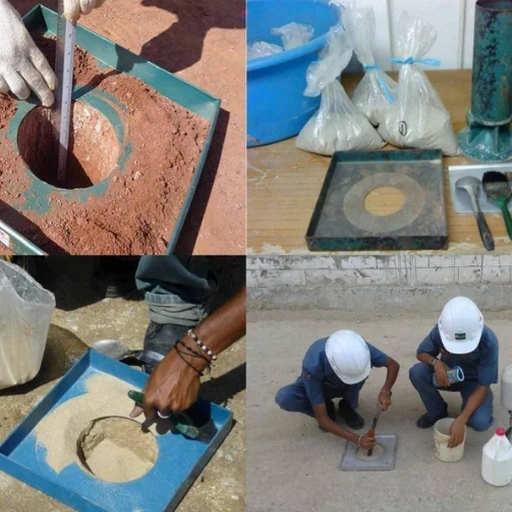
Newark's industrial past left a layer cake of ash, cinder, brick fragments and dredge spoils. The city's expansion after the construction of the Port Newark-Elizabeth Marine Terminal in the 1960s pushed development onto ground that was never naturally consolidated. Compaction control here is not just about hitting 95% Proctor. It is about understanding what you are compacting. We often run a companion grain-size analysis on the same material to confirm that the fill is within spec. The sand cone method works by excavating a small test hole, capturing all the removed soil, and backfilling the cavity with calibrated Ottawa sand. The volume of sand equals the volume of the hole. Wet density, moisture content and dry density follow. The result is a direct measurement, not an inference from nuclear backscatter. For sites near the Passaic River where groundwater is just a few feet down, we also recommend in-situ permeability testing to verify drainage characteristics of the compacted lift.
Field Density Testing Newark NJ — Sand Cone Method for Site Compaction
Technical reference — Newark

Local geotechnical context

In the Ironbound, we have pulled out chunks of buried asphalt the size of a dinner plate from a test hole that was supposed to be select fill. That one bad sample can fail an entire lift. The biggest risk we see is not low density. It is material non-compliance hidden beneath a passing compaction test. Newark's old industrial parcels often have pockets of slag or demolition debris that skew the Proctor reference curve. If the lab Proctor was run on clean borrow and the field test hits debris, the numbers do not match. The site gets a failing grade, the contractor gets a stop-work order, and everyone loses a day. The sand cone test catches these anomalies because you see the material in the tray. We advise contractors to run a test strip early and confirm that the fill source matches the Proctor sample. It saves re-work and keeps the project on schedule.

Need a geotechnical assessment?

Reply within 24h.

Email: contact@geotechnical-engineering.vip

Relevant standards

ASTM D1556 — Standard Test Method for Density and Unit Weight of Soil in Place by Sand-Cone Method, ASTM D1557 — Standard Test Methods for Laboratory Compaction Characteristics of Soil Using Modified Effort, IBC Section 1805 — Dampproofing and Waterproofing (compaction requirements for fill), ASTM D2216 — Standard Test Methods for Laboratory Determination of Water (Moisture) Content, ASCE 7 — Minimum Design Loads for Buildings and Other Structures

Technical data

ParameterTypical value
Test standardASTM D1556 / ASTM D1557
Calibration sandASTM C778 20-30 Ottawa sand
Test hole diameter4 to 6 inches typical
Minimum test depth1.0 x max particle size
Measured parameterDry density (pcf) and moisture content (%)
Acceptance criterion90-98% of max dry density per lab Proctor
Test frequency1 per 1,500-2,500 sq ft per lift per spec

Common questions

How much does a field density test cost in Newark?

A single sand cone test in Newark typically ranges from US$90 to US$130 depending on site access and the number of tests scheduled per day. We adjust pricing for volume: a full day of testing across multiple locations in Essex County is more economical per test than a single call-out. The price includes field density measurement, moisture content and a signed PDF report.

How deep does the sand cone test hole go?

The test hole is excavated to the full depth of the compacted lift being tested, which is typically 6 to 12 inches. The diameter depends on the maximum particle size in the fill material. For fine-grained soils we use a 4-inch hole; for fills with gravel up to 1.5 inches, the hole is widened to 6 inches to comply with ASTM D1556 requirements.

Can you test compaction in the rain?

Light rain is manageable if we protect the test area with a canopy and prevent surface water from entering the hole. Heavy rain changes the moisture content of the fill and invalidates the correlation to the Proctor curve. In Newark's summer thunderstorm season, we schedule sand cone testing for morning hours and keep a flexible backup window.

How many tests do I need for a warehouse slab in Newark?

The standard frequency under most Newark project specs is one test per 1,500 to 2,500 square feet per compacted lift, with a minimum of three tests per lift. For a typical 20,000-square-foot warehouse pad with an 8-inch select fill lift, you are looking at roughly 10 to 14 field density tests. We review the project specifications before quoting to confirm the exact frequency.

Location and service area

We serve projects in Newark and surrounding areas.

View larger map