GEOTECHNICAL ENGINEERING
NEWARK
HomeRoadwayFlexible pavement design

Flexible Pavement Design in Newark: Engineering for Urban Load Cycles

Evidence-based design. Reliable delivery.

LEARN MORE

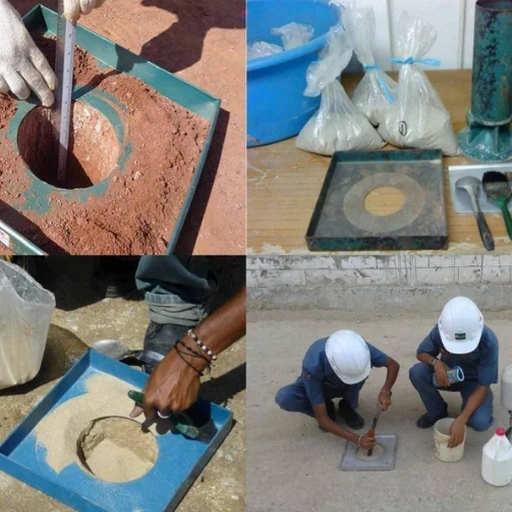
The Benkelman beam touches down on the prepared subgrade, its dial gauge steadying as the truck applies the standard axle load. In Newark, where the underlying geology shifts from glacial lake sediments of the Hackensack Meadowlands to the weathered shale of the Piedmont, these deflection readings tell the real story of subgrade support. We correlate the elastic rebound with the laboratory-determined resilient modulus, feeding the layered elastic analysis that defines the asphalt concrete thickness and base course gradation. The city’s 40.7° N latitude means the pavement section must also resist frost penetration depths that regularly exceed 30 inches. A CBR road test provides the soaked strength index we use to validate the structural number before approving the final pavement profile.

A correctly engineered flexible pavement distributes tire contact pressure through the HMA, base, and subbase layers so that the vertical stress at the subgrade interface never exceeds the soil’s bearing capacity.
Our service areas

How we work

Newark’s population density of over 11,000 people per square mile generates traffic load spectra that far exceed typical suburban assumptions. The design process for flexible pavement here must account for heavy bus routes along Broad Street, constant drayage trucks moving between Port Newark and the I-78 corridor, and the thermal cracking potential from winter lows averaging 24°F. Our laboratory-compacted Marshall specimens, prepared at 300°F mixing temperature, are tested for stability and flow under ASTM D6927 criteria. When a project requires full-depth reclamation, we integrate in-situ permeability testing to verify that the reclaimed base course meets the drainage coefficient thresholds specified in the AASHTO 1993 design guide, preventing moisture retention that would otherwise accelerate fatigue cracking under repeated loading.
Flexible Pavement Design in Newark: Engineering for Urban Load Cycles
Technical reference — Newark

Local geotechnical context

The rapid industrialization of Newark’s Ironbound district in the late 19th century left a legacy of fill soils composed of cinder, ash, brick rubble, and dredged organic silt. These uncontrolled fills, often 8 to 15 feet thick, present a highly variable subgrade with differential settlement potential that can destroy a flexible pavement section within two freeze-thaw cycles. Without a detailed triaxial testing program to measure the effective stress parameters of the fill, a standard pavement design will under-predict the rutting that occurs when saturated ash layers lose bearing capacity under truck loads. We have observed pavement failures along Ferry Street where the culprit was not insufficient asphalt thickness, but a 200% variation in subgrade modulus across a 50-foot span. The remedy involves selective over-excavation and geogrid-reinforced base layers to bridge the weaker zones.

Need a geotechnical assessment?

Reply within 24h.

Email: contact@geotechnical-engineering.vip

Video resource

Relevant standards

ASTM D1883 (CBR of Laboratory-Compacted Soils), AASHTO R 50 (Superpave Volumetric Design), ASTM D6927 (Marshall Stability and Flow), NJDOT Standard Specifications Section 400 (Bituminous Pavements), AASHTO Guide for Design of Pavement Structures (1993)

Technical data

ParameterTypical value
Design MethodAASHTO 1993 / NCHRP 1-37A (MEPDG)
Standard Axle Load18,000 lb (80 kN ESAL)
Frost Depth (Newark)30–36 inches
Asphalt Binder GradePG 64-22 (Superpave)
HMA Compactive Effort75 gyrations (Ndesign)
Structural Number3.0–5.5 (arterial)
Subgrade CBR ThresholdMinimum 6% (soaked, ASTM D1883)

Common questions

What is the typical structural number for a Newark arterial road?

For a collector or minor arterial in Newark carrying moderate truck volumes, we typically design for a structural number (SN) between 3.5 and 5.0, based on an assumed 20-year ESAL count of 2–5 million. The final SN is computed using the AASHTO 1993 equation with inputs for subgrade resilient modulus, drainage coefficients, and terminal serviceability index set at 2.5.

How much does a flexible pavement design package cost for a project in Newark?

The design package, including FWD testing, subgrade CBR sampling, Superpave mix design verification, and the final pavement structural report, ranges from US$1,670 to US$4,700 depending on the length of the alignment and the number of borings required to characterize the subgrade variability.

Do you account for the Meadowlands' organic soils in your pavement designs?

Yes. When the project alignment crosses former marshland or areas mapped as Hackensack Meadowlands deposits, we perform loss-on-ignition tests to quantify the organic content. Subgrades with more than 3% organics are typically unsuitable for direct paving, and we specify either a chemical stabilization protocol using lime or cement, or a complete removal and replacement with select granular fill compacted to 95% of modified Proctor density.

Which asphalt binder grade do you specify for the Newark climate?

We specify a PG 64-22 binder as the baseline for Newark’s climate, based on the LTPPBind 3.1 analysis for Essex County. The high-temperature grade of 64°C covers the seven-day maximum pavement temperature, while the low-temperature grade of -22°C provides thermal cracking resistance during the coldest winter nights when the pavement surface temperature can drop significantly below the air temperature.

Location and service area

We serve projects in Newark and surrounding areas.

View larger map