GEOTECHNICAL ENGINEERING
NEWARK
HomeSlopes & WallsActive/passive anchor design

Active and Passive Anchoring Systems in Newark NJ

Evidence-based design. Reliable delivery.

LEARN MORE

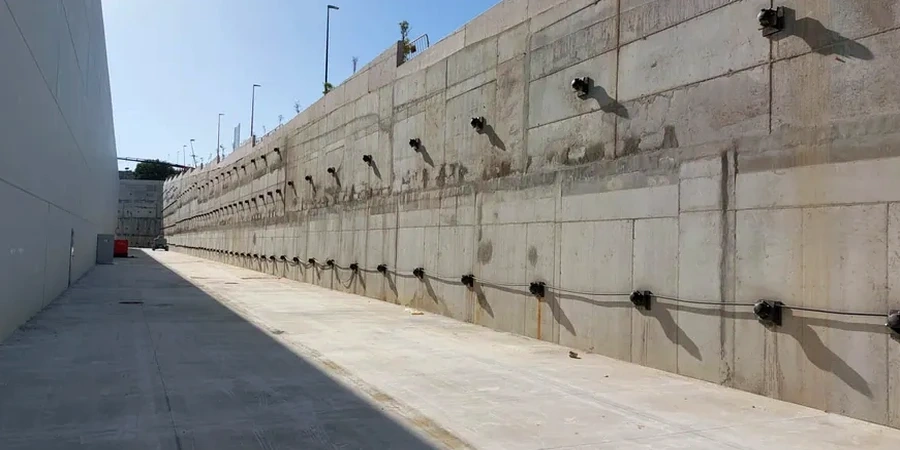
We still see contractors in Newark trying to restrain a 20-foot cut with undersized deadmen and a prayer. It fails. The Meadowlands fill and the deep glacial deposits demand a calculated restraint system, not guesswork. Our team designs active and passive anchor systems that manage the lateral earth pressures expected in the Passaic Formation. We calibrate the free length and bond zone to the actual soil profile on your lot. Before locking off a tendon, we verify the load with a hydraulic jack and a calibrated gauge. When you need to hold back a permanent soldier pile wall near the Passaic River, the anchor design has to account for corrosion and long-term creep. We also tie the subsurface investigation into the anchor bond capacity with a CPT test to refine the unit skin friction in the bearing stratum.

A passive anchor relies on the soil mass to mobilize resistance. An active anchor locks in the force from day one. Mixing the two concepts guarantees a failure.
Our service areas

How we work

Newark sits roughly 30 feet above sea level, but the subsurface drops through layers of varved clay, glacial till, and weathered shale. At the 2011 Virginia earthquake, some sites here saw amplified ground motion simply due to the soft soil profile. An anchor that works in rock upstate is useless in the organic silts common near the Ironbound district. We design anchors for the specific stratigraphy under your site. Our load tests follow ASTM D1586 for the soil characterization and we use load cells to confirm the lock-off load. The design differentiates between the unbonded length through the failure wedge and the bonded length in the stable zone. We often pair the anchor installation with a slope stability analysis to confirm the global factor of safety for the entire excavation sequence.

Key design parameters we control:
  • Tendon type: high-strength threadbar or strand system.
  • Corrosion protection class: Class I for permanent works.
  • Bond length calculated from the grout-to-ground interface friction.
  • Proof testing to 133% of the design load per IBC provisions.
Active and Passive Anchoring Systems in Newark NJ
Technical reference — Newark

Local geotechnical context

In Newark’s old industrial zones, we frequently encounter buried foundations and undocumented fill pockets. An anchor installed through a concrete obstruction loses all bond integrity. The biggest risk we see is a contractor applying the lock-off load before the grout reaches 3,000 psi compressive strength. That destroys the bond at the tendon-grout interface. The second risk is overlooking the surcharge load from adjacent buildings. A five-story brick structure on a spread footing imposes a significant lateral stress on the wall. We model that surcharge in the active earth pressure wedge. Without a performance test on the anchor, you cannot validate the creep rate. A creeping anchor loses lock-off load and the wall starts to deflect. That deflection cracks the pavement on McCarter Highway.

Need a geotechnical assessment?

Reply within 24h.

Email: contact@geotechnical-engineering.vip

Relevant standards

IBC 2021 (International Building Code), ASCE 7-22 (Minimum Design Loads), ASTM D1586 (Standard Penetration Test), PTI DC-35.1 (Post-Tensioning Institute Recommendations), ASTM A615 (Deformed Steel Bars)

Technical data

ParameterTypical value
Design StandardIBC 2021 / ASCE 7-22
Soil InvestigationASTM D1586 (SPT) boring logs
Grout SpecNeat cement, w/c ratio 0.45 max
Proof Test133% of design load (Performance Test)
Max Creep Rate2.0 mm in log cycle (acceptance criteria)
Corrosion ClassClass I (epoxy coated) or Class II
Lock-off Load70-100% of design load (active)

Common questions

What is the difference between an active and a passive anchor?

An active anchor is tensioned to a specific lock-off load immediately after the grout cures. It prevents movement. A passive anchor is not tensioned; it only develops resistance when the soil mass starts to move and pull on the bar. We use active anchors for permanent walls and passive anchors for temporary excavation support.

How much does an anchor design and test program cost in Newark?

The full engineering design and field testing program typically falls between US$1,080 and US$3,800. The range depends on the number of anchors, the required corrosion protection class, and the complexity of the soil profile.

Why is a performance test required on anchors?

A performance test cycles the anchor to 133% of the design load and holds it to measure creep. It validates that the bonded length is actually in competent soil and that the grout-to-ground bond will not degrade over time. It is a code requirement under IBC for permanent tiebacks.

Can you install anchors in the Meadowlands fill?

Yes, but it requires special care. The saturated organic silts provide very low skin friction. We design a longer bond length and use pressure-grouting techniques to improve the interface. We verify the capacity with a sacrificial test anchor before production begins.

Location and service area

We serve projects in Newark and surrounding areas.

View larger map